Translate

Wednesday, January 7, 2015

BABEL PART 2 of 2

BABEL, PART 2 OF 2


Peleg, which means "division," was the name which this particular descendant of Noah and Shem acquired by virtue of his presence at the scene of God's judgment of the Tower of Babel (Gen. 10:25). Surely, loving parents would not have named their son "Peleg" at the time of his birth, anymore than Nabal (= "fool"), the husband of Abigail, would have received such a name at his birth (cf. 1 Sam. 25:25)!

But the question remains: Why was mankind divided? I believe an answer may be found in this astounding statement by our Lord: "Do you suppose that I came to grant peace on earth? I tell you, no, but rather division [= Peleg!]; for from now on five members in one household will be divided, three against two, and two against three. They will be divided, father against son, and son against father; mother against daughter, and daughter against mother; mother-in-law against daughter-in-law, and daughter-in-law against mother-in-law" (Luke 12:51-53; cf. Matt. 10:34-36). God sent division as part of His gracious plan for His people.

Has not this been a major part of God's gra­cious plan throughout the ages? He had to DIVIDE Adam and Eve from Satan in order that the LIGHT of the proto-Gospel could shine into their hearts (Gen. 3:15). He had to DIVIDE Noah and his family from a godless world in order that the message of RIGHTEOUSNESS might be preserved (2 Pet. 2:5; Heb. 11:7). When the desperate desire for outward, organizational unity begins to overshadow the priority of TRUTH, then theological and spiritual dis­aster begins to loom large on the horizon. The God-revealed plan for SEPARATION from error and evil is thus an absolutely vital part of His saving love.

Thus, it was our Lord Jesus Christ, the Lord of history (Heb. 1:3; Col. 1:17), who DIVIDED ("peleg-ed") mankind into many hundreds of linguistically isolated people-groups (and now over 6,000!). (See "Voices of the World," National Geographic map, August, 1999.) "He made from one [Adam] every nation of mankind . . . having deter­mined . . . the boundaries of their habita­tion" (Acts 17:26; cf. Deut. 32:8). This has become an enormous obstacle to Satan's plan to permeate and spiritually destroy every human being on earth with "the deep things" of demonic blasphemy and perver­sion (Rev. 2:24). (For a study of the amaz­ing genetic/physical effects of isolation and inbreeding which resulted from the Babel dispersion, see Don Batten et al, "How did different 'races' arise?" in Answers to the Four Big Questions [Answers in Genesis, P.O. Box 6330, Florence, KY 41022], pp. 25-40).

Let us consider briefly the positive and the negative aspects of the Babel judgment with respect to God's love for the world (John 3:16). Positively, as we have seen, Babel has been God's enormous roadblock to Satan, just as the shorelines are God's post-Flood boundaries to the turbulent seas: "Thus far you shall come, but no farther; and here shall your proud waves stop" (Job 38:11). Billions of people today are thus relatively free from the total demonism that character­ized mankind just before the Flood (Gen. 6:5) and at Babel, even though pockets of special Satanic power have appeared from time to time in places such as Sodom (Gen. 19) and Pergamum (cf. Rev. 2:13).

Negatively, however, linguistic pluralism has proven to be for the Church, weakened by centuries of theological and spiritual corrup­tion, a great hindrance to the spread of the Gospel and the written Word of God, apart from occasional special divine enablement. The widespread use of Greek and Latin in the Roman Empire when the Church was created on the Day of Pentecost was God's provision for the Gospel message to reach millions of people in a relatively short period of time (Col. 1:23). But our Lord never intended the Gospel to be confined to Greek and Latin! He commanded us: "Make dis­ciples of ALL the nations . . . " (Matt. 28:19).

Just ten days after His ascension, a great lin­guistic miracle occurred: "There were Jews living in Jerusalem, devout men, from every nation under heaven. And . . . they were each one hearing [the apostles] speak in their own language" (Acts 2:5-6). Not just Greek and Latin, but a dozen other languages are listed (vs. 9-11)! Here was Babel in reverse: in the days of Peleg the earth was DIVID­ED; but in the days of the apostles thou­sands of people from many lands were UNITED for many months, "continuing with one mind . . . and continually devoting themselves to the apostles' teaching" (Acts 2:42-46). This was a preliminary answer to our Lord's prayer to His Father: "Keep them in Thy name . . . that they may be one, even as We are" (John 17:11). The ultimate answer to this marvelous prayer will surely occur one moment after the rapture, when we will all communicate perfectly with each other!

On the Day of Pentecost our Lord inaugu­rated His great program for removing the Babel language barriers that He Himself had erected. His Church, which is His Body and His Bride, was to break through every one of these thousands of cultural and linguistic walls, attracting people everywhere to the one true God by means of genuine love (John 13:35) and the pure Gospel (Rom. 10:9-15). Human isolation was to give way to SPIRITUAL UNITY and spiritual dark­ness to DIVINE LIGHT. "The Lord is . . . not wishing for any to perish but for all to come to repentance" (2 Pet. 3:9).

The Church, however, has only partly suc­ceeded in fulfilling the Great Commission. Several thousand languages, after 1,970 years, still have no part of the written Word of God. How tragic! How many of us will "suffer loss" at the Judgment Seat of Christ (1 Cor. 3:15) because of disobedience to our Lord's commands? Nevertheless, in the full­ness of time, God will follow through with His stupendous reverse-Babel program. Redeemed Israel, especially through the ministry of the 144,000 during the last half of the 70th Week of Daniel, will preach "this Gospel of the Kingdom . . . in the whole world for a witness TO ALL THE NATIONS, and then the end shall come" (Matt. 24:15).

At the end of this age, all of God's glorified people will sing a new song: "Thou ... didst purchase for God with Thy blood men from every tribe and tongue and people and nation" (Rev. 5:9). Indeed, there will be "a great multitude . . . from every nation and all tribes and peoples and tongues . . . and they will cry out with a loud voice, saying, `Salvation to our God who sits on the throne, and to the Lamb"' (Rev. 7:9-10). The curse of Babel, the division (peleg) of peoples, the separation of nations, and the confusion of tongues will end forever; and the wisdom and love of our great God, even in His judgments, will be understood in a new way by those who have put their trust in Him.

Tuesday, January 6, 2015

BABEL - PART 1 of 2

BABEL – Part 1 of 2


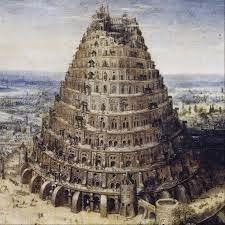
God's judgment of the Tower of Babel was one of the greatest catastrophes in the histo­ry of the world. In one moment, a massive, highly complex building project, involving the entire human race, came to an end. Thousands of workers, linguistically unified and Satanically inspired, suddenly found themselves incapable of communicating with each other. Overwhelmed by fear and frustration, each worker took his family and moved away from the others. Mankind has never recovered.

But what really happened, and why? For centuries, Bible students have wondered about the following three statements:

·  "Come, let us build for ourselves . . . a tower whose top will reach into heaven" (Gen. 11:4).

·  God's amazing response to this: "Behold, they are all one people, and they all have the same language. And this is what they began to do, and now nothing which they purpose to do will be impossible for them" (Gen. 11:6).

·  "In [Peleg's] days the earth was divided" (Gen. 10:25), and the relationship of these words to those in the previous chapter.

The Tower


Let us now consider these three statements in order. First, were these Mesopotamians who descended from Noah's family actually attempting to build "a tower whose top [would] reach into heaven" (11:4)? The clear answer is "No!" The NASB puts the words will reach in italics, which means that they are not in the original Hebrew text, but were added in an effort to make sense out of the wording. (The KJV italicizes may reach.) But what happens when the Hebrew word­ing is translated literally? We then have "a tower whose top [is] into heaven." (cf. NKJV). And this is exactly what ancient Mesopotamian ziggurat temple-towers were for! The top compartment represented heaven. The inner walls, in all probability, were decorated with blue glazed tile, with the sun, the moon, and the five known planets (Mercury, Venus, Mars, Jupiter, and Saturn) lined up along the plane of the zodiac. In the center of the room would be their "god" seated upon a throne! Nebuchadnezzar later rebuilt such a tower in Babylon, which the Sumerians had called E-TEMEN-AN-KI ("the building of the foun­dation-platform of heaven and earth"). (See J. D. Douglas, ed., The Illustrated Bible Dictionary Part 1, Wheaton, IL: Tyndale House Pub., 1980, p. 155.) The pyramids of Egypt and, much later, the great Mayan temples of Central America, reflected the design and function of the original Tower of Babel.

This was not an innocent, scientifically naive, primitive effort to reach the highest heavens! It was, instead, a brilliant but blas­phemous effort to dismiss forever the God who had commanded Noah and his three sons after the Flood to "be fruitful and mul­tiply, and fill the earth" (Gen. 9:1). Instead of honoring His name (i.e., His character and attributes), they said, "Let us build for ourselves a city . . . and let us make for our­selves a name; lest we be scattered abroad over the face of the whole earth" (v. 4).

The entire enterprise, devoid of reverence, respect, and obedience to the known will of Noah's God, simply reeked with human pride and arrogance. The entire human race, bonded by a common language, became Satan's stupendous instrument to dismiss God from His universe. Satan almost succeeded in dominating mankind again, as he had done at the fall of Adam and Eve, and as he had done before the Flood (with the exception of one family [Gen. 6:5; Heb. 11:7]).

The Response of God

The second statement which we must understand is the shocking response of God to the Babel project: "Nothing which they purpose to do will be impossible for them" (v. 6). The triune, sovereign God of the uni­verse, anthropomorphically viewed as com­ing down from the third heaven, through the immeasurable distances of "outer space," views this tower emerging from the tiny speck called earth with a sadness that only He can know, and pronounces judgment: "Let us . . . confuse their language.. . .So the LORD scattered them abroad from there over the face of the whole earth" (vs. 7-8).

But how did their linguistic unity provide the possibility and potential for infinite iniq­uity? Perhaps we can find the answer by looking at the vast English-speaking world today. Almost instantly, demonic perver­sions and poisons can penetrate and perme­ate the minds of millions through the inter-net. Avalanches of morally hideous films, videos, books, and magazines sweep across the U.S.A., Canada, the U.K., Australia, and South Africa daily, pouring into schools and homes like the locust plague of Joel 2:1-9, 25.

Now, what would happen to this Satanic sewage if the 322 million people who speak English suddenly discovered that their lin­guistic unity was shattered? The blow to Satan and sinful men would be staggering. The intervention at Babel was God's holy and loving purpose in dividing and separat­ing people from each other.

The Earth Was Divided

This brings us to the third significant state­ment: a descendant of Shem named Peleg was a living witness of this great judgment of God, for "in his days the earth was divided" (Gen. 10:25). Some have speculated that this division of the earth was the breakup and separation of continents after the Flood. However, these gigantic earth movements occurred at the very end of the Flood, and actually caused the Flood to end (see Psa. 104:6-9; and discussion in J. C. Whitcomb, The World That Perished, Grand Rapids: Baker Book House, 1988, pp. 37-42); but Peleg lived long after the Flood (see Whitcomb and Morris, The Genesis Flood, Phillipsburg, NJ: P & R Pub. Co., 1961, pp. 476-83).

The entire context of Genesis 10 makes it clear that the division which occurred in the days of Peleg was linguistic, not geological. Note this threefold emphasis: "the coast-lands of the nations were separated into their lands, every one according to his language . . . (vs. 5); according to their languages . . . (vs. 20); according to their languages . . . (vs. 31)." Thus, the linguistic division of
mankind described in Genesis 10 anticipates the more detailed explanation in Genesis 11, just as the brief statement of mankind's cre­ation in Genesis 1:26-28 anticipates the greater details of Genesis 2. Genesis 10 leaves the reader pondering these major questions: how and why did Noah's mono-linguistic family become "separated" from each other (Gen. 10:10, 31), speaking different languages (Gen. 10:5,20,31)? Genesis 11 pro­vides God's amazing answers.

Monday, January 5, 2015

DISPENSALIALISM - DEFINED AND CLARIFIED

DISPENSALIALISM - DEFINED AND CLARIFIED
"Whereof I am made a minister, according to the dispensation of God which is given to me for you, to fulfil the word of God." Col. 1:25"If ye have heard of the dispensation of the grace of God which is given me to you-ward:" "And to make all men see what is the fellowship of the mystery, which from the beginning of the world hath been hid in God, who created all things by Jesus Christ:" Eph. 3:2, 9

 
The Scriptures, when interpreted in their natural, literal sense, reveal divinely determined dispensations or rules of life which define man's responsibilities in successive ages. These dispensations are not ways of salvation, but rather divinely ordered stewardships by which God directs man according to His purpose. Three of these-the dispensations of law, grace, and the millennial rule of Christ-are the subjects of detailed revelation in Scripture (John 1:17; 1 Cor. 9:17; 2 Cor. 3:9-18; Gal. 3:13-25; Eph. 1:10; Col. 1:24-25; Heb. 7:19; Rev. 20:2-6).

Further Clarification Regarding Dispensationalism

When God's Word, the Bible, is taken in a consistent, literal manner it will result in dispensationalism. Dispensationalism is the result of a consistently literal and normal interpretation.
A dispensation is a unique stage in the outworking of God's program in time, whereby mankind is to have a believing response, being responsible to be a good steward of the particular revelation which God has given (Eph. 3:2, 9; Col. 1:25; Exodus 34:27, 28; Gal. 3:10-12; 1 Tim. 1:4; Eph. 1:10; etc.).
In order to be "rightly dividing the Word of truth" it is essential to distinguish things that differ and to recognize certain basic Biblical distinctions, such as the difference between God's program for Israel and God's program for the Church (Acts 15:14-17; Rom. 11:25-27), the separation of 1000 years between the two resurrections (Rev. 20:4-6), the difference between the various judgments which occur at various times (2 Cor. 5:10; Matt. 25:31-46; Rev. 20:11-15), the difference between law and grace (John 1:17; Rom. 6:14-15; Rom. 7:1-6) and the difference between Christ's present session at the right hand of the Father as the Church's great high Priest and Christ's future session on the restored Davidic throne as Israel's millennial King (Heb. 1:3; 10:12-13; Acts 15:16; Luke 1:32).

Sunday, January 4, 2015

OPPOSING VIEWS TO THE ASCENSION

OPPOSING VIEWS TO THE ASCENSION


Materialistic Theory
  • Denies an ascension in any sense.
  • Death was the end of Him.

The "Spiritualistic" Theory
  • Denies an ascension in a body.
  • Only His "spirit" ascended.
(But see the testimony recorded by Luke the physician: "a spirit hath not flesh and bones as ye see me have", Luke 24:39) "Behold my hands and my feet, that it is I myself: handle me, and see; for a spirit hath not flesh and bones, as ye see me have."

The body in which our Lord appeared to His disciples was His glorified body, the new body, of the same nature which ours will be in resurrection. When He spoke of "flesh and bones" it would seem as though there were no blood, at least that is often said and much has been made of it but to much so, for the very term "flesh" presupposes blood. At the same time it may be a description of the resurrection body, and a proof that there is no blood in it; but if that is so, we at once have to say we do not understand what flesh is. That, again, is of some other nature than what we know of flesh. Flesh as we know it is entirely dependent upon the presence of blood for life. Apart from blood it became carrion. There is absolutely no bearing upon the idea that the blood of Christ is in heaven. See also 1 Cor. 15:50. and Heb 9:12.
"Now this I say, brethren, that flesh and blood cannot inherit the kingdom of God; neither doth corruption inherit incorruption."
"Neither by the blood of goats and calves, but by his own blood he entered in once into the holy place, having obtained eternal redemption for us."

Saturday, January 3, 2015

PRACTICAL VALUES OF THE ASCENSION

PRACTICAL VALUES OF THE ASCENSION

 
 The Ramifications of God Coming to Earth in the Man Jesus:
1. Man will now know for certain what sort of character the eternal God possesses. What He calls good and what He calls bad as He humanly interprets His Words of truth called Scripture.
2. The facts about man and God, the perennial questions concerning such issues as pain and suffering, death, which create anxieties in men, the dim hope of a permanent world which is to follow-these and scores of other claimant questions will now have a fixed reference point by which they can be adjusted if not settled.
3. A man will be able to gain at first hand information as to "what life is all about" and as to how he can co-operate with the plan and the Power behind time and space and the created universe.
4. A man can look at Gods' words as He describes an absolutely unique event in the history of the earth and God Himself coping with life on the very terms that He has imposed upon His creatures. They will not be serving God seated on high on a throne, but down in the battlefield of life.

It Should Bring Joy to the Christian
John 14:28-29 "Ye have heard how I said unto you, I go away, and come again unto you. If ye loved me, ye would rejoice, because I said, I go unto the Father: for my Father is greater than I. And now I have told you before it come to pass, that, when it is come to pass, ye might believe."
The words were uttered in that period when He was the Self-emptied One, while still of one essence with the Father. By bringing this verse together with vs. 9 you touch the mystery of identity and yet difference. The declaration, "My Father is greater than I," must be interpreted by the whole context, where He was speaking of the witness of God to Himself, as a Teacher employing human speech and needing verification. The term "Son" does not necessarily imply inferiority, for in using it of our Lord we must cancel the limitations of time. Eternal Fatherhood and Eternal Sonship are both terms which break through the limitations of finite things, and leave us in the realm of mystery. The Son is to subject to the Father only in the sense in which He was the Servant of the Father, accomplishing a mission, after the completion of which, God becomes all in all.

It Should Arouse Interest in Heavenly Things
John 16:5-6 "But now I go my way to him that sent me; and none of you asketh me, Whither goest thou? But because I have said these things unto you, sorrow hath filled your heart."
Col. 3:1-4 "If ye then be risen with Christ, seek those things which are above, where Christ sitteth on the right hand of God. Set your affection on things above, not on things on the earth. For ye are dead, and your life is hid with Christ in God. When Christ, who is our life, shall appear, then shall ye also appear with him in glory."
 This is the greatest definition of prayer ever said. This definition does not suggest that the Christian is forevermore to be sighing after heaven, and expressing his discontent with the present world, and longing to escape from it; but rather that the Christian is to seek the upper things, seting his mind upon them, and everywhere and always he is to be hoping for, and endeavoring after, the ULTIMATE. That is the simple meaning of prayer. Reaching forward, wishing forward, desiring forward, seeking the upper, the higher, the nobler. So that in prayer there is included first, the thought of worship and adoration, that content of the heart with the perfection and acceptability and goodness of the will of God which bows its soul in worship. To always pray as Luke suggests in 18:1 is to always set the lifes inspiration and all its endeavor toward the ultimate goal of the glory of God. Paul also wrote to pray without ceasing in 2 Thes 5:17.

It Should Produce Steadfastness
Heb. 4:14  "Seeing then that we have a great high priest, that is passed into the heavens, Jesus the Son of God, let us hold fast our profession."

It Gives us  Great Assurance
Heb. 6:17-20 "Wherein God, willing more abundantly to show unto the heirs of promise the immutability of His counsel, confirmed it by an oath: That by two immutable things, in which it was impossible for God to lie, we might have a strong consolation, who have fled for refuge to lay hold upon the hope set before us: Which hope we have as an anchor of the soul, both sure and steadfast, and which entereth into that within the veil; Whither the forerunner is for us entered, even Jesus, made an high priest for ever after the order of Melchisedec."
The church having been counseled along with His oath resolves itself into an association of believers by which its growth, perpetuation, etc., is insured by the use of means of grace connected with such an organization, and by the care and oversight extended to it by its living Head. It is preparatory, because its office is, under divine assistance, to gather out of the nations the elect. It is simply calling and preparing "the heirs of promise," the "heirs of that kingdom which God hath prepared for them that love Him."
In this gathering out of believers to form this elect people-the inheritors-is found the ground for a firm belief in the perpetuity of the Church. God's purpose, no matter how adverse at times the Church's circumstances, how hostile the world, how corrupt her mixed condition, etc., will and must be inevitably carried out. The number that God has predetermined will be secured, so that His Theocratic Plan may be realized in power and glory.


It Shows that Heaven is a Locality
(Christ is there in a physical body.)

Shows the Marvelous Possibilities for a Glorified Body
The last part of our sanctification whereby we get the needed body that does not sin and last forever, for at last we are just like Him. 1 John 3:2 "Beloved, now are we the sons of God, and it doth not yet appear what we shall be: but we know that, when he shall appear, we shall be like him; for we shall see him as he is."

Adam and Eve were supernaturally and suddenly created by God; they did not gradually evolve from the animal kingdom. They were created physically; not just spiritually. They were created in the image and likeness of their personal, infinite, eternal Creator; not like animals which lack that image. They were created by God to exercise total dominion as "king and queen" over a perfect and complete world; they did not rule as subordinates to a fallen angel (Satan) in a world full of the marks of destruction, death or decay. They were not only unique in their physical perfection in all of human history, but were also the most brilliant human beings the world will ever know, apart from Christ, their incarnate Creator, until the day of glorification when all of God's people will be like Him when they see Him as He really is (1 John 3:2). Intelligence at a 100% level instead of 3-5% as we have today.
Surely the words of rebuke given by our Lord to the two on the road to Emmaus must be applicable to many Christians today: "O foolish men and slow of heart to believe in all that the prophets have spoken" (Luke 24:25). Our basic problem today in the question of origins and other Bible doctrine is not so much that we are ignorant of the theories and speculations of men. Our problem too often is that we know neither the Scriptures nor the power of God, and therefore deeply err in communicating God's message to modern man. May God be pleased to grant to each of us a renewing of our minds through submission to His special revelation of truth in His infallible Word, that we might prove what is that good and acceptable and perfect will of God.

Friday, January 2, 2015

THE GUARANTEES OF THE ASCENSION

THE GUARANTEES OF THE ASCENSION


For Christ Himself
Guarantees the Truth of His Claims
Matt. 26:63-64 "But Jesus held His peace. And the high priest answered and said unto Him, I adjure Thee by the living God, that Thou tell us whether thou be the Christ, the Son of God.
64  Jesus saith unto him, Thou hast said: nevertheless I say unto you, Hereafter shall ye see the Son of man sitting on the right hand of power, and coming in the clouds of heaven."

Caiaphas had no legal right to ask this question, but Jesus answered it anyway. When asked if He were the Messiah and the Son of God, He said yes. However, He persisted in calling Himself the Son of man.

Guarantees That Christ was Righteous
Psalm 24:3 "Who shall ascend into the hill of the LORD? or who shall stand in his holy place?"
John 6:62 "What and if ye shall see the Son of man ascend up where he was before?"
John 16:10 "Of righteousness, because I go to my Father, and ye see me no more;"
Righteousness would now have a new interpretation, and a new potentiality, because He was going back to the Father. There was the Cross. That is the way He was going. It was in His mind all through these intimate conversations and discourses. He was going that way, and because of that, because He was going through to the Father, victorious, righteousness would be made possible.

Guarantees His Final Triumph Over all His Enemies
Acts 2:33-35 "Therefore being by the right hand of God exalted, and having received of the Father the promise of the Holy Ghost, He hath shed forth this, which ye now see and hear. For David is not ascended into the heavens: but he saith himself, The Lord said unto my Lord, Sit thou on my right hand, Until I make thy foes thy footstool."
The Jews understood the meaning! cf. 37 - what shall we do? "Now when they heard this, they were pricked in their heart, and said unto Peter and to the rest of the apostles, Men and brethren, what shall we do?"

For Us as Believers
Guarantees That we Have an Advocate at the Right Hand of God
Heb. 4:14-16 "Seeing then that we have a great high priest, that is passed into the heavens, Jesus the Son of God, let us hold fast our profession. For we have not an high priest which cannot be touched with the feeling of our infirmities; but was in all points tempted like as we are, yet without sin. Let us therefore come boldly unto the throne of grace, that we may obtain mercy, and find grace to help in time of need."
Heb. 9:24 "For Christ is not entered into the holy places made with hands, which are the figures of the true; but into heaven itself, now to appear in the presence of God for us:"

Guarantees a Greater Ministry for Us in the World
John 14:12 "Verily, verily, I say unto you, He that believeth on me, the works that I do shall he do also; and greater works than these shall he do; because I go unto my Father."

Guarantees an Entrance for Us into Heaven Itself at Last
Heb. 6:20 "Whither the forerunner is for us entered, even Jesus, made an high priest for ever after the order of Melchisedec."

cf. Eph. 2:6 -- so certain that God counts it as done. "And hath raised us up together, and made us sit together in heavenly places in Christ Jesus:"
“raised up,” and “made [to] sit” together. These great truths are so certain to be accomplished that they are expressed in the past tense. Humanity was in the purpose of God from eternity past, in His eternal thought, and that man was created to share the eternal life of God, that man is to last while God Himself shall last, and so He has exalted man to His own right hand.

Thursday, January 1, 2015

THE ASCENSION AND CHRIST'S PRESENT WORK

THE ASCENSION AND CHRIST'S PRESENT WORK


Marks the Close of His Redemptive Work Upon Earth
Heb. 1:3 "Who being the brightness of his glory, and the express image of his person, and upholding all things by the word of his power, when he had by himself purged our sins, sat down on the right hand of the Majesty on high."
brightness of his glory “Brightness” is from a Greek word used only here in the New Testament, literally meaning “off-flashing.” In context of both this passage and modern astronomy, it could well be understood as “radiation.” As the “express image” of the Father, the Son of God is analogous to the life-giving rays from the sun. Just as the Father dwells “in the light which no man can approach unto” (1 Timothy 6:16), so can no man gaze long at the sun without being blinded. Yet, physically speaking, as the sun’s radiation provides both light and life to the world, so the Son is spiritually both the “light of the world” (John 8:12), and the “life” of the world (John 1:14; 14:6; Acts 17:28). See also notes on Psalm 19:1; 65:8; Micah 5:2.
word of his power. The eternal Son not only created all things by His omnipotent Word (Psalm 33:6; Hebrews 11:3) but is now “upholding all things by the Word of His power.” Note the remarkable relationship here between “things” and “power,” or in modern scientific jargon, between mass and energy. The atomic structure of our very bodies is being held together (or “sustained”—see note on Colossians 1:17) by mysterious nuclear forces or binding energies that keep the atoms from disintegrating into chaos. Scientists do not yet understand such energies or their origin—they merely name them! The fact is that we (and all things) are being upheld by the out-radiating energy of the Son of God, so that He is “not far from every one of us” (Acts 17:27), whether we believe in Him or not. “Where the word of a King is, there is power: and who may say unto Him, What doest thou?” (Ecclesiastes 8:4). This passage in Hebrews 1:2-3—like Colossians 1:14-20 and Romans 11:36—beautifully summarizes the past, present and future work of Christ in relation to the whole universe.
 by himself. The purging of our sins was accomplished solely “by Himself;” we have contributed nothing whatever to His great work of saving our souls.
sat down Therefore rested from the work of salvation He came to earth to perform.
 right hand. Out of the twenty-one references to Christ being at the right hand of the Father (the first being in Psalm 16:8), five occur in Hebrews (Hebrews 1:3,13; 8:1; 10:12; 12:2).


Exalts Him as Head Over All Things
Eph. 1:20-23 "Which he wrought in Christ, when he raised him from the dead, and set him at his own right hand in the heavenly places, Far above all principality, and power, and might, and dominion, and every name that is named, not only in this world, but also in that which is to come: And hath put all things under his feet, and gave him to be the head over all things to the church, Which is his body, the fullness of him that filleth all in all."
Eph. 4:9, 10 "(Now that he ascended, what is it but that he also descended first into the lower parts of the earth? He that descended is the same also that ascended up far above all heavens, that he might fill all things.)"
fill all things In John 14:28 Jesus said something which must not be as expressing all truth. Our Lord did say, "My Father is greater than I," but did He not also say in John 14:9, "He that hath seen me hath seen the Father"? By bringing these two together you touch the mystery of identity and difference. Moreover, the declaration, "My Father is greater than I," must be interpreted by the whole context, where He was speaking of the witness of God to Himself, as a teacher employing human speech, and needing verification. The term "Son" does not necessarily imply inferiority, for in using it of our Lord we must cancel the limitations of time. Eternal Fatherhood and Eternal Sonship are both terms which break through the limitations of finite things and leave us in the realm of mystery. The Son is to be subject to the Father only in the sense in which He was the Servant of the Father, accomplishing a mission, after the completion of which God becomes all in all.

Inaugurates Him Into His High-Priestly Work
Heb. 8:1-4 "Now of the things which we have spoken this is the sum: We have such an high priest, who is set on the right hand of the throne of the Majesty in the heavens; A minister of the sanctuary, and of the true tabernacle, which the Lord pitched, and not man. For every high priest is ordained to offer gifts and sacrifices: wherefore it is of necessity that this man have somewhat also to offer. For if he were on earth, he should not be a priest, seeing that there are priests that offer gifts according to the law:"
Heb. 7:26 "For such an high priest became us, who is holy, harmless, undefiled, separate from sinners, and made higher than the heavens;"
Jesus, our great High Priest, has “ascended up far above all heavens” (Ephesians 4:10). Yet the heavens seem to stretch out infinitely (see note on Isaiah 55:9). The only one who could ever be “higher than the heavens” is the One who created the heavens.

Makes Possible Christ's Present Work Through the Holy Spirit
John 16:5-7 "But now I go my way to him that sent me; and none of you asketh me, Whither goest thou? But because I have said these things unto you, sorrow hath filled your heart. Nevertheless I tell you the truth; It is expedient for you that I go away: for if I go not away, the Comforter will not come unto you; but if I depart, I will send him unto you."
Acts 2:33 "Therefore being by the right hand of God exalted, and having received of the Father the promise of the Holy Ghost, he hath shed forth this, which ye now see and hear."

The crowds had asked of Peter for an explanation of the sounds and sights that had just occurred and listed in Acts 2:2-4. Peter had remembered what Jesus has said days earlier. Cf. John 14:16-17. In the final charges delivered to the apostles, Christ distinctly commanded them not to depart from Jerusalem, but "to wait for the promise of the Father." (Acts 1:4) Here is the same thought, uttered by the Lord Himself, and here also He distinctly tells them when the promise was made, "which, said He, ye heard from Me." Thus it is evident that we are approaching an explanation of this statement. Christ had promised the Spirit, and He had done that in the name of the Father, for Whom He ever spake to men. Is there no definite account of His having made such a promise? Most assuredly there is an account, which is not only definite, but also detailed, and it is to be found in the Paschal discourses, which are chronicled by John alone. "I will pray the Father., and He shall give you another Comforter, that He may be with you forever, even the Spirit of truth: Whom the world cannot receive. (John 14:16-17) But the Comforter even the Holy Spirit, Whom the Father will send in My name." (John 14:26) "When the Comforter is come, Whom I will send unto you from the Father." (John 15:26) Thus in view of His approaching Cross, and in preparation of His disciples for the days when He in bodily form should be no more with them, He declared that in answer to His prayer, and in His Name, the Father would send them another Comforter, the Holy Spirit. Nothing is more evident in reading these discourses than the quiet majestic confidence of Christ. "I will enquire of the Father." "He will send you." "The Father will send in My name." "I will send you from the Father." That is the promise of the Father, and when the One Who made the promise to the band of disciples, ascended into heaven, the Father recognized the prevailing plea of His presence there gave Him the Spirit that He might fulfill the promise to the waiting men upon the earth. Peter said that all this means is that Christ has arrived in heaven and fulfilled what He had promised that He would ask the Father to send the Spirit. He has arrived at the destination He was headed for. We see and here the result of that prayer He made when He arrived.