Translate

Thursday, April 25, 2013

FAITHS NATURE-ITS MAKE-UP

THE NATURE OF FAITH
2 Kings 6:13-17

"Now faith is the assurance of things hoped for, the proving of things not seen."—HEBREWS 11:1
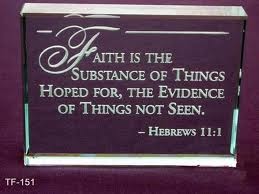

            These words constitute a declaration of the nature of faith. Faith is really the subject of the whole letter; for its purpose unquestionably was to establish and strengthen the early Hebrew Christians, who felt that they had lost so much as they had turned from the splendid ritual and ceremony of the Hebrew faith to the simpler things that are in Christ Jesus. This letter was written to save them from that form of lack of faith which becomes apostasy.
            The history of this world's progress is that of the triumph of faith. Faith is a paradox, something con­trary to reason, and yet true. In my boyhood I loved horses. I still love them. The law of the road is a paradox, and I was taught in rhyme:
"The law of the road is a paradox quite,
And that you may tell by my song,
If you go to the left, you are sure to go right;
And if you go right, you go wrong!"
            That is a perfect paradox; apparently wrong, contrary to reason, and yet true. So faith is always a paradox.
            Faith sings in prison, and not when it gets out of prison. Oh, it may sing when it gets out, but it antedates its escape by singing in prison, as witness Paul and Silas. Faith fights in chains. Paul said, "Remember my bonds." (Col. 4:18) Faith works and accomplishes things without any of the tools upon which men seem so largely to depend.
            It might be good to make a list of the literature of the prison, that which reveals faith triumphant. Jere­miah, Ezekiel, or Paul, and John. All in prison. Or down the centuries, 200 years ago, John Bunyan, whose great drama was composed in prison. The prophecies of Jeremiah and Ezekiel, the writings of Paul and John, the matchless beauty of Bunyan, were all created by faith. If the test of a word is a work, if the test of a creed is a creation, if the test of a root is a fruit, faith is abundantly vindicated through all the running cen­turies.
            We ask this question then: Why is it that faith thus triumphs? This wonderful section of the letter, as we have seen, really commences in the previous chapter (10). There the writer quotes from Habakkuk when he declares the great principles of the victorious life, "The just shall live by faith." We ask then: What is this faith? In this study we commence to answer that question. In the said words we have a clear-cut crystal­lized definition of faith. The first word of the text is "Now," the little word that links the argument of the letter directly with what the writer said previously, "My righteous one shall live by faith." Missing out the intervening words for the moment, he said, "Now."
            Faith is the assurance of things hoped for, the proving of things not seen.
            Before going any farther, I want to say two things of a gen­eral nature. This is the only definition of faith to be found in the Bible. There are explanations and appli­cations, but here is a clear-cut definition, and the only one. Again, the definition is not complete. This is a definition of faith in the abstract. There is a concrete fact, consideration of which we do not reach here, but to which we come in our subsequent articles.
            There are in these words two very simple and self-evident things. This definition first of all reveals the spheres in which faith operates; and within the defini­tion, that which so operates in those spheres.
            First then, the sphere of operation. "Faith is the as­surance of things hoped for, the proving of things not seen." The two spheres, nevertheless one in the last analysis, "things hoped for, things not seen." Those are the two realms in which faith becomes operative. There is no need to illustrate that, apart from the Biblical literature, although it could be done. It is true in every realm of life.
            "Things hoped for." What are they? Things not yet attained, things not in our possession. "Who hopes for that which he sees?" We enter the realm of the future when we speak of things hoped for. Let us ask ourselves: For what are we hoping? I am not thinking on the level of the dust now, where
"The earth of a dusty today
Is the dust of an earthy tomorrow."
            I am thinking on high levels now. What are we hoping for? The realization of our ideals, the ultimate victory of good, compensation for all the things which have to be endured, and the enduring of which is contributing toward that ultimate compensation. We hope for a time when in human life and affairs an even balance shall be struck. Take any position you will. Call it what our thinkers call it sometimes, "the golden age," or think of it in terms of the poet, who sang of
"The far-off Divine event,
To which the whole creation moves."
            "Things hoped for." There may be times when hope seems to flicker to the lowest, and hardly gives any light. We have all known such times; but the things hoped for, the aspirations of the soul, that is the sphere in which faith operates.
            The second phrase, "things not seen." That is diffi­cult. At least it seems to be so. It does seem easy, naturally, to believe in things we can see. Faith does not operate there at all. We do not need any faith to believe in things seen. We have all heard the old say­ing, "Seeing is believing." Is that true? No! Be­lieving is being sure without seeing. Faith operates there in the presence of things that eye has not seen, things that have not entered into the understanding of the mind. That is the realm of faith.
            Are there any such things? There is only one an­swer to that. As we read the wonderful illustrations of faith given us by this writer, he says of one man, that "he endured, as seeing him who is invisible." A great and glorious statement! Such an absurd thing, is it not, you worldly-wise man? Seeing the invisible! That is faith. That is the sphere in which faith operates in the spiritual world in the midst of which we are always living, even in the dust of the city. The unseen things, the hidden forces that are everywhere, if we could see them. We cry out, "Master, what shall we do?" (Luke 3:12) But the man who can see, says, "Lord, open his eyes," (2 Kings 6:17) and the Lord in the ancient story opened his eyes, those eyes that are more than human sight, and "Behold, the mountain was full of horses and chariots of fire round about." The young man had not seen them, but they were there, unseen things. What a wonderful story that is, and how perfectly it illustrates this: the faith of Elisha, and the sight that came to his servants. Some of us may be thinking of those lines of Wesley, in his great hymn:
"Lo, to faith's enlightened sight,
All the mountain flamed with light.
Hell is nigh, but God is nigher,
Circling us with hosts of fire."
            We cannot see these things, but they are there, and faith enters into that realm.
            With great reverence, Jesus had this vision when His hour of travail came. "Thinkest thou that I cannot beseech my Father, and he shall even now send me more than twelve legions of angels?" (Matt. 26:53) He did not ask for them, but He saw them, and saw the possibility. Faith entered into the realm of the unseen. When we cease to believe in unseen things, hope dies, and the song is silent, and fighting ends, and the work is aban­doned. To quote again words concerning Moses, he "endured as seeing him who is invisible." (Heb. 11:27)
            The "things hoped for" is the sphere in which faith operates; the realm into which we climb when thought becomes longing, aspiration, and strong desire. Faith enters into that realm.
            Second, "the things unseen," the things that can­not be proven mathematically. There are so many things we cannot prove mathematically that we know are so. No one can prove that the woman he or she called mother was their mother. Produce the birth certificate. That is worthless. But we know; faith has entered into the realm of mystery, and we are sure. That is the sphere of operations.
            Let us turn now to the definition, which is abstract, and not final. What is faith? It is "assurance, prov­ing." Those are the two words of the Revised Version. The Authorized Version reads: "Faith is the substance of things hoped for, the evidence of things not seen." The Revisers have substituted "assurance" for "sub­stance," and "proving" instead of "evidence."
            But the Revised Version still lacks something meant by the writer. A far better rendering of that word, hupostasis, is the simple word confidence; "faith is the confidence of things hoped for." Confidence! Cer­tainty which produces action. It is not merely confi­dence in the sense of being sure that it is so; but a confidence that becomes conviction. That is faith ex­actly, confidence, certainty of things hoped for; cer­tainty of the ultimate realization of our ideals, the ultimate victory of good, and the striking at the moment of an even balance everywhere, with a great sense of com­pensation and realization. Faith is sure about things hoped for.
            What is "proving"? What is "evidence"? Evi­dence is proving offered. We give evidence, which means we are offering proof. The Revisers have im­proved the old rendering, by translating "proving." There is an added shade of meaning here. If evidence is proof offered, proving is proof offered and accepted. It is not merely that evidence is given, but it is so given that it produces actual conviction. "Faith is the con­fidence of things hoped for, the conviction of things not seen." The writer here is proceeding from effect to cause. What is the effect?             Confidence of things hoped for. What is the cause? Conviction of things not seen.
            Here is the mental process. Faith, first, is a convic­tion of the reality of the unseen. Second, confidence that all the terms will be fulfilled, that the vision will be translated into victory. Faith enters that realm. Con­viction of things not seen is the confidence in things hoped for. The conviction of the builder is the confi­dence that the city will be built. The conviction con­cerning the unseen realities is the confidence of the realization of ideals. It is an abstract definition, but what a definition! How it gives us pause for thought!
            Can we apply it individually, and to the Christian Church, and to the world at large? Unless faith enters that realm of unseen things, and becomes conviction, there is no certainty about faith at all, there is no guar­antee. It is faith that grasps the reality, reaches out to the unseen, and then focuses upon it, acts upon it; and that hope is no longer mere hope, in a speculative sense, but becomes a great certainty.
            These are the things that have created all the great victories and triumphs of our human progress, so far as there has been progress. Men first become sure of the unseen, and when sure of the unseen they become sure of the ultimate victory of the ideal. If we are not sure of the unseen, we are without hope, because without God in the world. In the presence of such a definition I take the language of the man who came once to Jesus and said, "Lord, I believe, help thou mine unbelief." (Mark 9:24)

Wednesday, April 24, 2013

HEROS OF THE FAITH 1

"MY RIGHTEOUS ONE SHALL LIVE BY FAITH"

Habakkuk 2:1-5; Romans 1:16-17; Galatians 3:10-11; Hebrews 10:36-39

"My righteous One shall live by faith."—HEBREWS 10:38 (RV)

            The subject of faith has occupied my mind very much in these strange and perplexing days through which we have been passing. The word is the commonplace of our holy religion. The word, however, is oftentimes vitiated by false or partial interpretation. With this in my mind I have been driven back to the great classic passage in the Bible which covers the whole area of human life, this eleventh chapter of the epistle to the Hebrews.
            Neither the prologue to chapter 11 (10:37-39) nor the text I have taken therefrom defines or illustrates faith. In this prologue we have the declaration of a principle, and a revelation of a philosophy of life. In that way we approach them now. The words were cited by the writer, from Habakkuk. They also occur in two other places in the New Testament. The three passages we read, one in Romans, one in Galatians, and here in this 10th chapter of Hebrews. The declaration of it in the Old Testament, and the citations of it in the New, are very significant.
            Let us first of all consider the setting of the words in the Old Testament, and their citations in the New; then attempt to consider the principle of a philosophy of life revealed in these words.
            The setting of the text in Habakkuk is most suggestive. This prophecy may be described as an account of the agnosticism of faith. It is not so much a prophecy as a story of the experience of one man. That man was a prophet unquestionably, and in that sense it is a prophecy through an experience, which he has recorded for us in this brief book that bears his name.
            These were dark days in the history of the people of God. The national conditions were appalling. Concerning that fact he first spoke in the presence of God. He spoke of the prevalence of violence, and iniquity, and pride abounding in the national life. The international situation was threatening. Enemies seemed to be closing in upon this nation, and the difficulty for Habakkuk was this, that God seemed to be negative, waiting. He seemed to be doing nothing. That is how the prophecy opened. Is our world in the same situation and setting?
            Then we are told that God answered him. Again reverently to change the wording, in an expression of the truth; God said to him in effect: It is true you think I am doing nothing, but I am. I am at work; but, if I told you what I am doing, you would not believe it. Then God did tell him what He was doing, that He was raising up the most cruel and brutish peo­ple of the times, the Chaldean s, to be His instrument for the carrying out of His purpose in the world, and among His people.
            Habakkuk then said in effect: This is worse than ever. It seemed bad enough if God were doing nothing; but now He tells me that He is using these people, the terror of the nation, for His own purpose. I do not understand it. I will get myself to the watchtower, and I will wait. In that moment Habakkuk came to the greatest decision that was possible for a human soul in those circumstances. The man of faith has often been perplexed, overwhelmed with the difficulties of the situation, and the hour in which he lives; and more troubled about this than anything else, that God seems to be doing nothing!
            We have often heard that in recent times. What is God doing? Why doesn't God do something? God is still saying the same amazing thing: I am at work, though if I told you, you would not believe, or understand, but the fact remains. I am raising up and using in the working out of My purposes in the world, the very people or peoples concerning whom you are filled with dread. When God says that, it is time for us to shut our mouths. That is what Habakkuk did. But he did not shut his ears. Again in effect, he said: Well, I am not questioning what God has said, but I do not understand it. I will get myself to the watchtower, and I will wait for God.
            The trouble with us is that too often we do not wait to see what God would say to us. In these circumstances of helplessness the prophet decided to wait for God, and having so decided, God answered him. Mark his words: "And the Lord answered me." What did He say? He sent him a vision. This does not mean He actually appeared to him at all. The Hebrew word for vision means very simply a mental conception, an outlook, and a revelation. The oracle of God spoke
to him: Let me give you a vision, an interpretation, a final point from which to view all the circumstances and events; and then write it on tablets, not that he who reads may run, but he who runs may read. This man who is busily occupied in a thousand ways—running, tearing along—make it so plain that as he passes by, he can see it. That is the claim that the vision should be written on tablets, made plain, so conspicuously that the running, racing man may see it. Do not be in a hurry. Tarry for it, wait for it. It will surely come. That is the simple, initial statement.
            What was the vision? As we go back to Habakkuk we find that after that charge, that declaration of a vision, and a charge to write it and make it plain, the vision is declared, "Behold, his soul is puffed up, it is not upright in him; but the just shall live by his faith." That is all. The remainder of the chapter is an almost detailed exposition of the first half of the vision, "Behold, his soul is puffed up." There is no exposition of the second half. It does not need it. It is a simple statement.
            We have here two philosophies of life; first, that of the puffed-up. I like the translation, but let me slightly alter it, "the swollen." It is a graphic figure of pride and self-sufficiency. That is one philosophy of life, puffed up, swollen, filled with pride, and filled with self-sufficiency. The other figure is this, "the righteous one shall live by faith"; a sense of certainty in spite of appearances, and a condition of consequent trustworthiness; for the word "faith" here is rendered by some "faithfulness." The meaning of the Hebrew word, as also the Greek, has the twofold application.
            When Jesus said to Thomas, "Be not faithless, but believing," He did not merely say, You should have faith, but, having faith you should be trustworthy. It is the same thought here.
            So the whole meaning is covered in one of the simplest of sentences. I use it resolutely and reverently, in some senses the mightiest sentence in the Book of God. It is the revelation of the true philosophy of the Biblical history from the primeval movement in Genesis to the Apocalyptic Revelation. The theme all circles round this, "The just shall live by faith." The two issues and the two philosophies are there.
            Read the rest of the second chapter of Habakkuk for the picture of the puffed-up, and make any application of it to the age in which we are living. John Wesley said he read the newspaper to see how God is governing the world. When I am tired of the newspaper I go back to the Book. When I am tired of the trivialities and the prattle and the toys of time, I go back to the voices of the old Hebrew prophets, and place the meas­uring line of Habakkuk's philosophy on the disturbances everywhere in the world at the present hour. Yes, let us wait! Read this chapter through at your leisure, honestly, and think as you read; and you will see that the ultimate issue of the swelled-up or swollen attitude to life is explosion. Watch the balloon that the child is playing with. Look at it, blow it up, and keep on blowing it. If you do, Puff! It is gone! By the swelling it bursts. That is the story of human history, and it is the story of individual life as well. The soul that is self-centered and self-sufficient, the soul that is arrogant, and struts in the presence of Almighty God, sooner or later collapses, and there is break-up. The balloon is pricked and bursts.
            What about the other? There is no chapter about the other. One word only is needed. What is it? "The just shall live." The word marks power of continuity. The word marks reality, the realization of victory and life. "Live by faith!"  How? By being not proud, self-centered, self-satisfied. The swollen ends in dissolution. Faith ends in a perfect realization. That is the setting of the text.
            The citations of this statement in the New Testament are remarkable in their placing, in Romans, Galatians, and Hebrews.
            The letter to the Romans is pre-eminently the document of human salvation. Galatians is pre-eminently the document of liberty, rightly interpreted. Hebrews, from first to last, is pre-eminently the document of faith. In these three great writings dealing with salvation, liberty, and faith, these words are cited, and in remarkable connections.
            The apostle, writing to the Romans, said, "I am not ashamed of the Gospel." The Gospel is the good news that tells how men can realize all that in which they have failed. There it is, instantly flashing like a central, burning light on the page: "The just shall live by faith." That is the issue of the Gospel.
            The Galatia n letter is the document of freedom that deals with the emancipation from every yoke of bondage that can be placed upon the human soul. "It breaks the power of cancelled sin." It breaks the tyranny of the law, of every imprisoning habit. In the midst of it Paul says, "The just shall live by faith."
            He shall enter into freedom, find salvation in the Gospel, enter the joy of absolute freedom, and the principle is faith.
            And last, the letter to the Hebrews is pre-eminently the document of faith, and reveals the principle of triumph over all sorts of conditions as revealed in the eleventh chapter. But in every case it is the Gospel for the world. Faith is the principle of life. It is the emancipation from all tyranny. Faith is the principle of liberty. It is the secret of victory in all circumstances.
            It remains only for us to consider the principle as declared. That principle is revealed in this contrast between pride and self-sufficiency on the one hand, and faith or confidence on the other hand. Pride and self-sufficiency are equal to provocative exploits. Let us make no mistake about that. Not only as we glance back over the Biblical history, but look out on the world as it is. Pride and self-sufficiency are equal to great exploits. But look back and see the lust of self-sufficiency, and all exploits growing out of it will sooner or later collapse. Whether it be a man or a nation, the same thing is true.
            On the other hand, confidence is equal to many things, to exploits oftentimes mysterious, and far more wonderful than the exploits of the proud. Look again at the eleventh chapter of Hebrews, and see there what faith is equal to, and in every case it ends in vindication of itself.
            Two philosophies of life. Not only the contrasts are true; but the positive declaration. Faith is the principle of life. Not decay, not death, not dissolution; but the principle that furnishes, that continues, that achieves.
            But let it at once be said that this message is very unfinished, I will not say inadequate. Faith is not defined in our text. A definition is found in the eleventh chapter, and the assertion is merely what the writer of this letter cited from Habakkuk. It is an assertion, sharp, clear, challenging, bold, daring; but no illustrations are given in the text. They are all massed in the eleventh chapter. Yet we do not stay there. That eleventh chapter is unfinished, just as in some ways the Acts of the Apostles is unfinished. We might go on multiplying illustrations a thousand, a million-fold.
            Faith must be interpreted by this Biblical literature. Faith may be a creed, valuable in its way, yet having no living power. Faith may represent something far short of the Biblical meaning. But Faith in the Bible is always something that reaches through until it touches God; through the smoke of battle, through the murk and misery that appall us, through the darkness of the hour, through the threatening forces of evil that seem so rampant—through, and beyond that, behind that, better yet above that, to God. Faith is that which reaches Him and touches Him.
            The attestation of the truth of the great declaration, of its twofold nature, is attested in human history of the world. We remember the story of Alexander, that when he had conquered the whole known world he went to see the philosopher, Diogenes, living in his tub. Alexander stood at the entrance and called to him. A voice said, "Who art thou?" He said, "I am Alexander, the master of the world." "Is that so? Get out of my sunlight." The great philosopher was able to dismiss as an arrogant fool the master of the world. Diogenes added, "Go, and learn to be wise. Conquer thine own spirit, and take no light thou canst not give." The proud and the puffed-up, and the great explosion!
            Augustus Caesar came nearer to hegemony, or governing the whole world, than even Alexander. How did it end? This applied to pagan rule: "Rome has perished! Write that word in the blood that she has spilt; Perished hopeless and abhorred, deep in ruin, as in guilt."
That is what happened.
            So at this hour, or near to our own time. What about Napoleon? We could name other names also. No despot who is governing as the result of pride and self-sufficiency can possibly continue. There must inevitably be an explosion, dissolution. If we are living by faith, then though it may be through scourg­ings and mockings and perils and dangers, we shall arrive, for "the just shall live by faith."

Tuesday, April 23, 2013

THE BIBLE AND THE EVANGELICAL FAITH

THE BIBLE AND THE EVANGELICAL FAITH

            Long, long ago there was the Edict of Henry VIII, seventy-three years before the King James' Version, and we recognize that in that Edict we discover the hand of the over-ruling God, It did not depend upon the Sovereign himself in any sense; but we thank God for the thing that happened, and for the chained Bible. The chain is gone, and the Bible is with us of the Evangelical faith today.
            The theme announced has infinite possibilities which it is not my intention to attempt to explore, It would be futile to make any such attempt in a necessarily brief consideration, I want rather to follow the line of inclusive simplicity, dealing with what the writer of the letter to the Hebrews spoke of as "the first principles of the oracles of God,"
            The subject then, "The Evangelical Faith and the Bible," consists of a phrase in which two matters merge, the Bible, and the Evangelical Faith. The one is concrete, the other is abstract, they are, however, intimately related, of which, more shortly.
            Our method will be quite briefly and simply first, a question in the realm of the abstract, what is the evangelical faith? Second, a consideration of the relation of that faith to the Bible,
            What do we mean when we speak of the evangelical faith? It is good sometimes thus to ask ourselves what we mean by things we easily say, We are very apt to take things for granted, and imagine we know them, when we do not know them at all, I agree with Josh Billings who said "I'd rather be certain of a few things, than know so many that ain't so."
            The word faith may be used in two ways quite naturally, first of individual action, I said action, not sentiment, because we believe that Professor James was right, there is a will to believe, Or we may use the word faith of a system of belief, It is in that second sense that we employ it now,
            The phrase then, the evangelical faith, refers to the whole body or system of truth concerning which there is confidence and assurance, Whether we speak of faith as an individual action, or as the system of belief, it has a common quality, and that is one of assurance, of confidence, Faith is not gullibility. Faith is not guessing, Faith is not hoping, Faith is being sure, "Faith is the assurance of things hoped for," because it is "the evidence of things not seen," We are thinking of the faith, as Paul thought of it when writing to the Philippians he spoke of "striving for the faith of the Gospel"; or as Jude thought of it when he said, "The faith which was once for all delivered to the saints,"
            The Christian religion is distinguished from all others in this fact, The faith is not a quest, It is confidence in a revelation, and consequently it is a revelation in itself, Just as logos may stand for the thing spoken and the method of the revelation, so with the faith, As I have said, faith is not a quest, I am told that I ought to be engaged in a quest for truth. I am not so engaged, I am engaged, and have been for half a century in an attempted diligent study and question into the truth as it has been revealed to man from God, That is my understanding of the faith,
            Now we come to the word, Evangelical, This is the predominant note, What does evangelical mean? The announcement of good news, that is very elementary, but it is final. I have always had very great sympathy with the Scot who was sitting waiting in a dentist's outer room, He had to wait some time, and the dentist found him looking at a book, which was an English dictionary; and when the dentist expressed some surprise, the Scot said, "Oh it is verra interesting, but the stories are unco' short"! In the Oxford Dictionary I found six and a half columns of cognate words, all round about the word evangel; and all the six and a half columns again and again, in many connections and applications, stressed the word Gospel, good news, That is the evangelical faith,
            Thus, when we speak of the evangelical faith two ideas merge in the mind, First it is a message, not the announcement of a human discovery, but the declaration of a Divine revelation, Secondly it is good, it brings comfort, it brings confidence, it brings courage, The evangelical faith is the con­fidence, the assurance, based upon a Divine revelation, which is good news for a storm-tossed and wounded world, to every man in his deplorable condition of helplessness,
            Second then, what is the relation of the Bible to the evangelical faith? Everything I have already said is the outcome of the Bible, Take this Book away, and the world has no evangelical faith, We may discuss with great appropriateness com­parative religions, Great attempts have been made to find a common denominator, It never will be found, There is no common denominator if Christianity is included, A common denominator may be found in the rest, There is no evangelical faith apart from this Book, There is no direct message from God to man claimed by any other form of religion of which I know anything, and I have not been utterly idle in consideration of such matters,
            And certainly there is no assurance of comfort, of confidence, of courage, or hope, The study of other religions is full of interest, But what is found in them? Questing, wondering, hoping; but no assurance, no finding, no answer to the questing; no solution, no reply to the wondering; no promise in the presence of the hope,
            But in this Book its claims are very clear and definite, It claims to be a message from God to man, I will dare to gather up the whole of the evangelical faith into a brief statement, What is this message of God to man which constitutes the bedrock of the evangelical faith? For the moment I am not asking anything about its implications or its applications, for that is an almost infinite sphere of consideration, and most important, But what is the essence? I submit that the profoundest student and professor of theology, and the most recent recruit of the Salvation Army will agree with me that the whole message of the evangelical faith is found in John 3:16, Yes, I think we had better repeat it, "For God so loved the world, that He gave His only begotten Son, that whosoever believeth on Him should not perish, but have the life of the ages, eternal life,"
            That is the highest message of the Bible, That is the supreme declaration that God has made to man, not only in the Literature, but in the Person of His Son,
            But we are thinking of the Literature, and that is the absolute message of the Bible, If we follow it through as a growing manifestation, we find it proceeds from a glimmering twilight to the full­-orbed sun-rising, That is the Faith, The back­ground is a perishing world, but all round it is a God of love, and the fact that that God has made a way of redemption and renewal for that perishing world, That is, as I understand it, the evangelical faith, We are in the glimmering twilight as we read the ancient and poetic history, and hear God whisper into the heart of a woman, in view of all the tragedy resulting from acts of rebellion, a hope that there should come a Seed that should bruise the head of the serpent, From that first whisper down on through the messages of prophets, seers, and psalmists, never complete, through singing, sighing, sobbing and hoping, it was a message rightly read, of God's love of a perishing world, and His purpose to save that world,
            Reverently let it at once be said, that is the Cross, The evangelical faith is centered there, It can be nowhere else, The Cross, not as a martyrdom, not as an example, but a mystery, a manifestation, and a clear message, All that is in this Book, It is its message, We do not know anything about the Cross until we come here. We do not know anything about God until we come there, that is the faith of the Book,
            Some men today are merely concerned with what can only be termed the Social Gospel, Alexander McLaren, was asked the question, How far should a man be warranted in attempting to deal with con­ditions, individual, social, and economic? Alexander McLaren said, "Put one foot of your compass on Calvary, and swing the other as wide as you can, You are limited by your compass, but keep one foot in the Cross, If you do so, you will be true to the evangel in every application of life," I believe that to be true.
            In the year 1800 there was one, John Burton, who was a great friend of Robert Hall, and a great lover of children, He wrote a little volume of Hymns. Here is one of the best from that book:
"Holy Bible, book divine,
Precious treasure, thou art mine;
Mine to tell me whence I came,
Mine to teach me what I am,
Mine to chide me when I rove,
Mine to show a Saviour's love;
Mine art thou to guide my feet,
Mine to judge, condemn, acquit,
Mine to comfort in distress,
If the Holy Spirit bless;
Mine to show by living faith
Man can triumph over death,
Mine to tell of joys to come,
And the rebel sinner's doom;
Holy Bible, book divine,
Precious treasure, thou art mine,"

BIBLE TEACHERS NEEDED

THE NEED FOR THE BIBLE TEACHER

            The title of our present article may need some interpretation or explanation, I want to stress the importance and urgency of the work of Bible teaching, I distinguish at the outset between preach­ing and teaching, All preaching ought to be teaching in some sense; and yet there is a teaching office and work which is by no means preaching,
            There are three Greek words in the New Testa­ment, two of them referring to preaching, and one to teaching. The word kerusso means to proclaim, to herald, There is the word euanggelizo, which means to announce good news, The word didasko means, in the fullest sense of the word, to teach, All preaching is, or ought to be, an authoritative delivery in the name of the King, If it is not that, it is not worth listening to, All preaching should have in it the element of the Gospel, or the an­nouncement of good news, When those two things are granted, in proportion as the prophet is obeyed, and the call of the evangelist is accepted, and men and women are brought into the place of submission, in that proportion the need for the teacher arises,
            Our method is a very simple one: first the consideration of an account, and then the application of its values to the subject under discussion,
            The account is in Acts 8:26-35, There are two things in it which will lead us to the point of our consideration, two questions, The first was Philip's question, "Understandest thou what thou readest?" and the second was the eunuch's answering question, "How can I, except someone shall guide me?"
            There are three things to notice in this account. There is a sacred writing, and there are two men, First, a sacred writing, the Prophecy of Isaiah, It is interesting to note that evidently Luke, the writer of this account, believed that Isaiah wrote the second part of the prophecy, Looking back at his ministry, we see that it was conducted in difficult times, and produced great results temporarily; for all the work of Hezekiah unquestionably grew out of Isaiah's prophesying,
            Then this eunuch was a remarkable man, a Hebrew proselyte, most probably a black man, an Ethiopian, In that remarkable civilization of its time, over which Candace was queen, he was treasurer in authority and office, Brought up in the midst of the paganism that characterized these people, he nevertheless had heard of the one God, and had become a proselyte to the Hebrew faith, and he had been up to worship at the feast, He was a man, devout, inquiring, singularly intelligent, That he was intelligent is gathered from the question he asked Philip, He was reading, and reading aloud, and when Philip joined him, Luke is particular to tell us he was reading in what we call our fifty-third chapter, and that the question he asked was this, "Of whom speaketh the prophet this? of himself, or of some other?" It is a remarkable fact that that has been the question asked all down the centuries about that chapter of Isaiah, and some scholars are still arguing about it, and have given different opinions—that Isaiah was talking about Jeremiah, or of himself. So this man was moving in the realm of serious thought,
            Philip had no question in his mind on the matter, "Beginning from this Scripture," he "preached unto him Jesus," Philip was not an apostle, but a deacon-evangelist, one of those elected to the office of deacon, but having the gift of the evangelist, Probably he had given up the service of tables, which was the service of the diaconate, and had abandoned himself to the work of evangelism, He had had a marvelous time in Samaria, He was filled with gladness with his knowledge of Jesus, That is what he had been preaching, and he had seen wonderful things happen in Samaria,
            So the three things: a sacred writing; a devout, earnest, questing, inquiring soul, the eunuch; a Christian man, withal an evangelist, burdened with a glad burden, that of his Gospel, a man in such fellowship with the Spirit of God, and so with his Lord, that when he was told to leave successful work, he immediately obeyed, He did not know for what he was going, He had no program given to him, All he knew was he was to travel on a road through a desert country, and he went, Then it all happened,
            We come now to the two questions, Philip heard the eunuch reading, and went to him, and asked this question, the simplest of all questions in the presence of any kind of reading, "Under­standest thou what thou readest?" That is the real question with regard to all reading, What is the use of reading if one does not understand? It is an arresting question, We have all known what it is to be reading, and then suddenly to come to the consciousness that we do not know what we have been reading, and we have had to go back and read it all again, Do we understand what we are reading? The Greek word there simply means to know, do we know what we are reading? The parchment was unrolled before the eunuch of the court of Candace, but did he know what he was reading? Did he understand it?
            That question is of special importance in the presence of the Sacred Writings, If it is important in the matter of all reading, it is most important here, Did we understand what we read this morning? Or was our reading just a fetish or a habit? Because if we did not understand, we may just as well give up reading. This is a most important question Philip asked the eunuch,
But more important is the eunuch's reply, "How can I, except someone shall guide me?" There was recognition on the part of the eunuch of the importance of Philip's question, He did not
challenge him, He did not say it was a rude question, He was reading earnestly and sincerely, but he did not understand, he was baffled, He did not know who was this strange suffering Servant of Jehovah passing through travail until now He broke into triumphant song, No, I do not understand, and how can I, except one shall guide me? If I am to travel the highway intelligently I want some­one to guide me, who knows the way, and can show me the way, and lead me, That reveals the importance of Bible teaching, All over the land today, and everywhere, there are faithful souls picking up the Bible, and yet they are baffled by it, puzzled by it, Unfortunately, for lack of someone to lead and guide them, someone who knows the highways of the Biblical revelation, knows the path­way over the mountains, and the flowers and beauties under the skies of God with their clouds and stars, they are lost; and the trouble is they put the Bible down, and give it up as a Book not understandable.
            In Bible teaching we start with certain facts, First, the Sacred Writings themselves, God-breathed, We may take up the Bible and treat it as we do other literature, but ultimately it cannot be done, It will prevent our doing it sooner or later, That is the Bible we have, God-breathed writings, Those are what we are called upon to teach,
            Second, we have not only the writings; we have the Holy Spirit, the Spirit of God to guide us into truth, Not to give us the truth systematized and finished, and put out in parcels, so that we hold the truth, God help any man who thinks he holds the truth, It is the work of the Spirit to guide into all truth,
            Then we have the gift of the pastor and teacher, On the other hand, we are confronted with the average student, whose life calling demands the principal part of time and strength, and refuses such from that attention to the Writings that he would fain give, When someone says with a sigh of regret, "I would like to give more time and attention to these Writings, but I am so fully occupied that I cannot escape," then I know I am facing a need in the soul that says that, for someone to help, someone to guide, and that is the place for the Bible teacher,
            That is the ultimate work of the Christian minister and preacher, He is set free from the
secular callings of life that he may consecrate his time to these Sacred Writings, and work all the week at them, in order that when his people gather he may guide them, and lead them into the sacred truths of the Sacred Book, Any man in the ministry who is frittering his time away, on a hundred trifles, and neglecting the hardworking, sweating pre­paration for his pulpit, is renegade to his calling,
            Some may say, "There are many who have not all that time"? But they have a certain amount of time, I think they would do well, many of them, if they would consecrate time to the helping of others, gathering a few round them so to do, Some of you women, why not have a drawing-room meeting for Bible study? I could select twelve to twenty different women who could do that work as they met groups of people here and there, who have not the time, who it may be are reading, but are not understanding what they read, I am thinking of this work for women especially more than men, I am not suggesting that they have nothing to do, but I do remember the old Scripture that says,
The Lord giveth the word;
The women that publish the tidings are a great host.
            I should like to see that fulfilled; perhaps as it never has been, Why not make a hobby of it? Is that degrading it? What is a hobby? I looked it up in the dictionary, and I see that a hobby is "a subject to which one constantly reverts; a favorite subject of discourse, of thought, or of effort," Make a hobby of teaching the Bible! I will give another definition from another lexico‑
grapher, "A hobby is a favorite avocation," The definition goes on to draw a distinction we seldom make in thinking, but it is important, Vocation is something you are called upon to do, Avocation is the diversion to something else you are not bound to do, A hobby is an avocation, You have a vocation, but why not have an avocation, and especially such a sacred one as this? Multitudes of people are waiting for this, whom the preacher in his pulpit or the teacher at his desk never can reach; but it is a great thing if he can say something to send others out to reach them,
            What are we to do with these people? First give them instruction as to methods of Bible study, Guide them in their reading, Try to show how the whole interprets every part, and every part has its connection with the whole, Take time yourselves to explore, and then to explain to them the words that are made use of, for words are carriages in which ideas ride. Then try and show them the spiritual values, A great method of teaching should be that of catechism, I do not mean the old idea of a man or woman with the book, and a boy or a girl without it, Let the student ask the question, and you answer it, That is the catechetical method, in that sense of asking questions, and holding fellowship around the Word,
            The need and opportunity are great, The need is great for the teaching of these Scriptures, in the interest of religion, of economics, of society, of politics, of commerce, of art, of recreation, There is no department in life where these God-breathed writings have no value, As Paul said in that passage in 2 Timothy, these Sacred Writings are profitable for authoritative teaching, for reproof—that is, testing; for correction—pulling back into the straight; for discipline in righteousness, going on with the building, until it is complete, Take these writings, and put them by the side of personality, beginning with the baby until we reach the man at his work, There are those everywhere needing the help of these writings, We can go to them and say, "You are reading, Do you understand?" If they are honest, they will join with the eunuch and say, "How can we, except someone shall guide us?"
            The teacher's great business is to make himself unnecessary, If the teacher is necessary, the sooner he is gone the better, In our little account, read on, and see what happened, The eunuch went on his way, and the Spirit of the Lord caught away Philip, But the eunuch went on his way, He had heard of Jesus, starting with the Sacred Writings, He had found a man who knew the road, and led him and guided him; and when that man had done his work, the Spirit of the Lord took him away,

THE BIBLE AND THE CHILD: THE METHOD

THE BIBLE AND THE CHILD: THE METHOD


THE BIBLE AND THE CHILD: THE METHOD

           
THE BIBLE AND THE CHILD: THE METHOD

            This is our second article dealing with the Bible and the child, We approached the first with that paragraph in Paul's second letter to Timothy, at the end of the third chapter, in which we saw the relation of the Sacred Writings to the develop­ment of personality, suggested by those two phrases, "a babe" and "the man of God" at work,
            In our previous article we saw that the goal of all religious instruction is salvation; that the way of salvation is through faith in Christ Jesus; and that the mental condition for the exercise of that faith is that of the wisdom or knowledge, which comes from a knowledge of the Sacred Writings by which the parents can aid in that process.
            In the light of these things, we ask what are our obligations, the responsibility resting upon us to make the Sacred Writings known to the child, that it may have the knowledge which leads to Christ, and reposing faith in whom, may find its way into the experience of salvation,
            Our first obligation is that of a recognition of modern revelation in the realm of teaching, Some might use in that connection the word "discovery," I prefer the word "revelation," because I believe that every discovery of man is, in the last analysis, a revelation of God, and that in every realm of life, I am thinking now of the science of teaching, The basic principle, the discovery of which has altered the whole method of teaching since my young days, is that to which I now refer, The old idea was that the teacher should impart information and cram the mind of the scholar, We used to talk about education, misusing the word, Education means drawing out what is there, and instruction is imparting to the mind what is not there; and the two things are necessary in all teaching,
            It was the discovery of this fact that it is not enough for teachers to know their subject, they must also know the child, In the old days it did not matter at all about the child, The child was expected to take what the teacher gave, and the teacher knew the subject, and poured it out, and the child was expected to get and hold it, Now we realize that there must be the recognition on our part of the capacity of the child to receive,
            This applies to Bible teaching, It is not enough to know the Bible, we must know the child, We must be acquainted with the child mind, and must adapt our impartation of knowledge to the capacity for the receiving of that knowledge,
            It is of fundamental importance that we recognize this comparatively modern discovery, And yet is it modern? There is a complete philosophy of psychology in Paul's words in the New Testament, I will content myself, however, with an older reference from the Old Testament:
"Train up a child in the way he should go,
And even when he is old he will not depart from it." (Prov. 22:6)
            Do we know what that means? The old idea was that it was the duty of father and mother, or teacher as the case may be, to make up their mind the way in which the child should go, and then to see to it that he or she went that way, But look at that a. little carefully, In the Hebrew text there is no word "go," There is one little word which may be written peh in English, and the statement here is, "Train up a child according to his own way," That may frighten some people, Does that mean the child is to have its own way? Absolutely, But be careful, It does not say the child is to have its own wish or desire,
            The first word "train" is arresting, That Hebrew word is only translated "train" in one other place in the Bible, when we read about Abraham and his trained men, In other places the Hebrew word is translated to direct, to dedicate, For us there is no better word than "train," if we understand it means the leading out into realization of what is in the child, "Train up a child in his own way," Oh, the horrible mistake of trying to take some child and make it like some other child, Every child has its own way, its own capacity, Every child has something peculiar to itself, the secret germ and force of personality; and our first business is to recognize that,
            Our second obligation consequently is that of the application of the values of this revelation or discovery in our instruction of our children in the Sacred Writings, Take the child when it is in that early stage until it comes to about eight years of age, Watch that little one, and see it has every element in human personality, I am not going into the finer nuances of psychology, I am content to fall back upon Kant's analysis of personality, in which he said personality consists of three faculties, elements, or phases: intellect, emotion, will,
            No one will doubt that these little ones have will power, or that they have intelligence and emotion, But this is the remarkable thing, In those little children, while those elements are all present, they are never working together, They act separately, That accounts for the glorious physical restlessness of the child, First the child is in the realm of the intellect, as a little girl was, who asked her uncle, an Oxford don, "Uncle, why is that rose red, and the leaf green?" Her uncle was delighted that his sister's child manifested such intelligence, and he said, "Gladys, I am so glad you have asked that, If you will get that little chair and come here I will explain it to you." By this time Gladys was laughing, He said, "My darling, what are you laughing at?" To which she replied, "I am so sorry, Uncle, but you have got such a funny face," She had forgotten her intellectual question, because her emotion was stirred in the presence of her uncle's face, He was a little annoyed, she was not there, She had forgotten the problem and her uncle's face, and she had gone off down the garden,
            Somewhere round eight years of age a change takes place, and for the next period of years, eight to eleven or twelve, watch the mind of that same girl or boy, Intellect and emotion grow, and will recedes, Then they will ask more questions than ever before, or ever will again until they are seventeen, Emotion? They are full of it, but will has receded, it is not absent, that is the easiest period for discipline, the child's will is not its highest consciousness,
There is another change somewhere round twelve years of age in every normal boy or girl, It is the most remarkable and volcanic change that takes place in the development of personality, Intellect recedes, but it is not dead, They will cease asking questions about things, one reason being that they do not want anyone to think there is anything in the heavens above or the earth beneath that they do not know! That is always a sign of arrested development either in a child or a man, Emotion is positively crushed now, No healthy girl or boy will let you see them cry, But will has sprung up, almost in a night; and the child in that period is now beginning to elect, to choose, to select, to exercise its right of choice, God help father, mother, teacher who does not recognize that right,
            In a brief statement I will repeat what I told him. Whenever a boy or girl comes to that moment of the manifestation of will, quit commanding and begin communing. Get down by the side of the boy, and talk to him, of the girl, and talk to her; commune with them, and show them reasons,
            That period ends somewhere in the teens—fifteen to seventeen, then what happens? The same qualities are seen, but intellect comes back again in multiplied questions, Emotion has a strange awakening, into all the details of which I will not go! Will is there, and once again in that developing personality the same elements are seen as in the little one, and, if I may use the term, they are the same in bulk just as in the wee children, with this difference, In the little ones they acted independently, and crisscrossed, Now the three are coming into co-operation, Will moves to the center of personality, and emotion flanks it, so does intellect; and emotion and intellect
appeal to will, which is the final arbiter, and will decide, always on the basis of what emotion or intellect says, If at that point the light in them is darkness, if emotion has become debased, and intellect has become clouded, the decisions will be disastrous, but the fact remains,
            All that is a very rough attempt to see the develop­ment of personality, and that is the reason of grading in our schools, It is not the fad of a few fanatics, It is intelligent co-operation with God,
            Our third obligation then is that of facing the task, difficult though it may appear to be, of dealing with the Sacred Writings so as to co-operate with this development of character, To put it simply, it means the Sacred Writings must be presented to each stage of development so that the interest of the child is never lost, but held,
            The account (better account) is all the child wants, and it is all it needs, or is capable of receiving, How they love the account! Only do not make the mistake of explaining it to them, They will sit still while the account is told, but not when it is explained, Why not? Because they have seen something, perhaps something out of the window! But the account holds them, I will tell you what happens, when you tell the account, mother, teacher, to a little child, The child will forget it in thirty minutes, and remember it in thirty years, You have planted down in that little child's mind something it forgets, and remembers on the other side of the world thirty years after,
            What about the next stage, the period after eight and up to eleven or twelve? The period when will recedes, and intellect and emotion come to the fore? At that time they want something more than the account rounded off, They want the account going on, That is the period when children love to take in a magazine that has an account "to be continued in our next," There are some older people who read these accounts, but it is a sign of second childhood! Now in teaching the Bible we go over the same ground, but show how the accounts link, and that in the simplest way, That is the period when the Bible is taught most successfully by taking the great biographies, They want at that age to see how this man's life was related to that man's life, They are ready for his account, We take them over the Bible now from that standpoint of the great movements of his account, What a chance teachers have in that period of instilling into the minds of those developing boys and girls the Biblical philosophy of his account, What is the Biblical philosophy of his account? That there is one Throne, and that all other thrones are subservient to it; that they rise or fall according to their relationship to that one Throne; and all human inter-relationships of the family and society and nationality are based upon the authority of that Throne, That is what the Bible teaches us, We must show that historic move­ment to those minds that are beginning to be social, The gang spirit is born in this period, They want to go together, and to see men act together, and all national movements are seen seething in the melting pot of the thinking of boys and girls from twelve to sixteen or seventeen years of age, They will be held if we give them Bible his account, with that foreground of Hebrew his account, and the background of the other nations as they appear; and then the brief span of human his account when Jesus was here, and all the forces round Him,
            When we move up to what we call the higher levels, the special emphasis is on teaching, the moralistic values, We take the Laws of Israel, the Prophets, the Psalms, and the Epistles, and the teaching of Jesus centrally, Then the whole Bible is in front of them, nothing hidden, nothing omitted, nothing added, the special emphasis being on its teaching,
            Our final obligation is that through all these processes we never lose sight of the final purpose, we teach the writings in order to make wise, we make wise in order to inspire faith; we inspire faith in order to secure salvation. How beautiful is that marvelous analysis of the value of the God-breathed Writings! Paul said, profitable "for teaching," That means authoritative statement, upon which we can build, "Reproof," that does not mean rebuke, The root of the word means the plumb-line let down by the side of the wall, to show if it is in the straight, We build on what we find in the teaching, We prove our own building with the plumb-line of the Bible, "Correction," literally pulling back into the straight, In the Bible we find the way of putting the building back into the straight, And then "discipline," Instruction is discipline going on, until the man is complete, not only complete in personality, but complete for service, perfect in every good work,
            The work of Bible teaching to the young is in the interest of the individual, of family life, of the State, and of the race, When we are teaching children, knowing their minds, knowing the Book, adapting the giving of the Book to the child mind, we are doing wondrous work, work for today, work for tomorrow, and work for the undying ages of eternity for the King.

Monday, April 22, 2013

THE BIBLE AND CHILDREN NEEDS

THE BIBLE AND THE CHILD: THE NEED
"From a babe," until the "man of God ..… be perfect, furnished completely unto every good work,"

            In considering the subject of the Bible and the Church we took as a basis a passage from Paul's first letter to Timothy, In dealing with this subject of the Bible and the child, I propose to take a paragraph from his second letter to Timothy, found in the third chapter, the final paragraph, beginning at verse 14 (RV): "But abide thou in the things which thou hast learned and hast been assured of, knowing of whom thou hast learned them; and that from a babe thou hast known the Sacred Writings which are able to make thee wise unto salvation through faith which is in Christ Jesus, Every Scripture inspired of God is profitable for teaching, for reproof, for correction, for instruction which is in righteousness; that the man of God may be complete, furnished completely unto every good work,"
            These words contain the complete philosophy of religious instruction, or a complete philosophy of the value of the Bible in the development of personality, Notice the period covered, "From a babe," until the "man of God,…., be perfect, furnished completely unto every good work," The whole of personality is there, from the baby to the man equipped for his work in the world,
            In that paragraph the Sacred Writings are thus placed down side by side with the development of personality, Here we find the philosophy of religious in­struction, or Bible teaching, both as to germ and norm, It is here in germ, It needs development and application, But it is here in norm, which means that there must be no development that contradicts it at any point, as to its philosophy or as to its method, The paragraph is complete,
            These words were written by Paul to Timothy, whom he described in this letter as "my beloved child," and in the former as "my true child in faith," While it would be interesting to linger with Timothy's story, suffice it to say he was won for Christ when Paul was going through that period in which he was left for dead outside Lystra, after his stoning, At that time this youth was brought to a knowledge of Christ, and surrendered to Him, From the earlier reference we learn that Timothy had been born and nurtured in the atmosphere of faith, for the apostle declared that faith dwelt first in his grandmother Lois, and then in his mother, Eunice, Thus we have the picture of this boy from his childhood, in the care of these two women, That is the meaning of Paul's word to him, when he said, "Abide thou in the things which thou hast learned," Had Timothy learned them from the apostle? By no means, who, then? It was his grandmother and his mother, who had taught him the Holy Letters first,
            Turning from the immediate apostolic applica­tion, let us consider the philosophy revealed, seeking to apprehend its value as it reveals the need for teaching these Holy Writings, these Sacred Writings, this Holy Bible, to the child,
            Four matters emerge, First, the goal of all religious instruction is "salvation," Notice, "From a babe thou hast known the Sacred Writings which are able to make thee wise unto salvation," That is the goal, the ultimate,
            Second, the way of salvation is "through faith which is in Christ Jesus,"
            Third, the mental condition for the exercise of faith is that of the wisdom, or knowledge, which comes through the Sacred Writings,
            Fourth, the responsibility which rests upon those who have charge of children in any way is that they should make known the Sacred Writings,
            We start, then, with our first deduction from this passage, It is that the goal at which we aim in all such instruction is salvation, I do feel that much of our Sunday-school work today is suffering because that is not realized, Young people are asked sometimes if they would not like to take a class, and they do so without remembering that the children they have to teach, the little ones, or the older ones, need salvation, and that the purpose of all Bible instruction to the young is that of arriving at that goal,
            Salvation is the theme of the Christian Church, The word "salvation" is central to the Christian religion, "God sent not His Son into the world to judge the world; but that the world should be saved through Him," (John 3:17)
            Let us remind ourselves of the value of the word, It postulates danger, but it promises safety, It recognizes the forces which destroy, and proclaims the possibility of their destruction,            It implicates weakness, but it offers strength, It faces failure, and provides a way of recovery and realization, Salvation. It is the bright, shining glory against the dark background, the glory of divine provision against the background of human failure,
            The word must be adequately interpreted when we think of it, As to time, salvation is progressive, As to extent, it is inclusive, As to value, it is utmost in human life,
            As to time, it is progressive, We can use different tenses when we speak of salvation, It is quite competent for us to say, "We were saved," and it may be when we say that we are remembering a day and a date and a place, Perhaps we are not, Perhaps some have no date or place to remember, I remember the very moment, when I came to the consciousness of sin against Jesus Christ and my need of salvation, So we can also say, we were saved so many years ago; past tense, But it is equally correct to say we are being saved, "The Lord added to them day by day those that were being saved." That is the process, Salvation not only has its past in the "I was"; or the pro­gressive present in the "I am being saved"; but it has its glorious future in which we say, "Now is salvation nearer to us than when we first believed," (Rom. 13:11) It stretches through all time as to human personality,
            As to extent it is inclusive, When people tell me they are concerned about the salvation of souls, I always want to ask them what they mean, Salvation is not merely for the soul, It is for the whole man, the whole woman, the whole child, the whole of personality, It is inclusive,
            As to value, it is utmost, That, I am not arguing here, That is the core and center of the belief of the Christian Church when it is true to its Evangelical faith, It is far more important that your boy, your girl should be saved than that they should get on in the world, It is best, Narrow interpretations of salvation are pernicious, It is for mind and body as well as spirit, It is for today as well as for tomorrow, for time as well as for eternity; and nowhere is it of more importance that we should recognize this than when we deal with our children,
            Why teach them the Bible? Because of their salvation, that bright and spacious and marvelous thing that has to do with the yesterday and today and the tomorrow of every individual life, Sal­vation is that tremendous thing that takes in spirit, mind, and body, the whole of personality, Salvation is the need,
            Where shall we find anything about that? Everyone knows the answer; in the Bible, and nowhere else, No other literature deals with that subject, There is no other form of religion extant that suggests it as a possibility with which to confront derelict and failing humanity, Sal­vation is the theme and goal of all Bible teaching,
            With equal brevity consider the next matter, The way of salvation is through faith which is in Christ Jesus, We remember that the whole possi­bility of human salvation is summed up in Him, He saves from danger, He destroys the destroyer. He gives strength, He realizes the whole of per­sonality, as to time, He is patient, as to extent, He is persistent, as to value, He realizes His own preciousness in the believing soul,
                        The condition, then, of appropriating all that which is in Christ Jesus is that of faith, What is faith? Knowing that no definition ever yet has been full and final of anything either in the heavens above or the earth beneath, a definition of faith cannot perhaps be complete, Nevertheless, I say that faith is volitional surrender to intellectual conviction, Faith is not intellectual conviction alone, If we only have intellectual conviction we have not the faith that brings us into salvation through faith in Jesus Christ, To intellectual conviction there must be added volitional surrender. The simple illustration is this: here is a chair; it is a good chair, I go into the house of my friend, and he says "You look tired," I am tired; I am very tired, "Take a chair," and he offers me one, Now, if we are intelligent beings we never sit down on a chair without having first gone through an intellectual process of inquiry as to its safety! I have glanced at chairs, and refused to sit in them, So there is an intellectual process, Will that chair bear me? It will, I am intellectually convinced that the chair will bear me, Is that faith? Oh, no; at least it is not the faith that gives me any rest when I am tired, I say to my friend, "Yes, thank you so much, I am so tired; I am so much obliged to you," It is a wonderful chair—but I keep standing, He will say, "Why don't you sit down?" Then I sit down, That is faith, I yield to my conviction, I venture my weight upon it, whatever it may be, I trust it, That is the faith that saves,           First, intellectual conviction; and then the venture of confidence, the trust that reposes, Finally, therefore, faith is an act performed, and then it becomes an attitude maintained, That is the faith in Christ Jesus that brings men into sal­vation, It may come, that act of volitional surrender, as unconsciously as the blush of the dawn breaking over the mountains, so that we hardly know when it came, So it came to me, Or it may come in an eruption, volcanic and terrible, with fire and thunder, So it has come to multitudes, It does not matter whether this way or that, It is that act of saying, "Yes, I will trust Thee, trust Thee with my soul, and I will crown Thee Lord of my life," It may be so natural that one can hardly tell when it happened,
            It is so good when a child is so trained that it comes to the mental condition for the exercise of faith in Christ, That mental condition is that of the knowledge that comes from acquaintance with these Sacred Writings, Let the children know what these writing really say, Faith always presupposes knowledge, Knowledge presupposes truth, and results from instruction in the truth, When the child is familiar with these Writings, is intelligently taught, then it has the wisdom, But that has not brought salvation. It has led, as these Writings always lead, to Christ Himself; and when the child, instructed in these Writings, comes face to face with Christ, it is natural, it is easy for it to say, "Yes, I am His, and He is mine," There is great importance, therefore, that we should teach the Bible to the child, That is the need,
            So, brethren, the responsibility of those who have charge of children is that of making known these Sacred Writings, It cannot begin too soon, The moment the child is intelligent enough to say anything to you, it will be intelligent enough to hear, Begin to acquaint that little mind with some­thing of the Sacred Literature, It should be intelligently done, which means it is not enough to know the Bible; we must know the child. That subject is postponed to our next article. The work should be thoroughly done,
            This is not final work, but it is fundamental, Even this intelligent instruction of the child in the Sacred Writings cannot compel faith, but it makes it possible, it makes it easy. No, father and mother, you cannot compel your child to an act of faith in Jesus Christ; but you can make it almost impossible for a child not to exercise that act of faith, The father and the mother cannot compel the child to be a Christian, but the child will have a much easier choice, because of what they did for that little one, and what the little one saw in them, There is the need, and the responsibility; and as to method, God willing, we consider it more carefully in our next article,